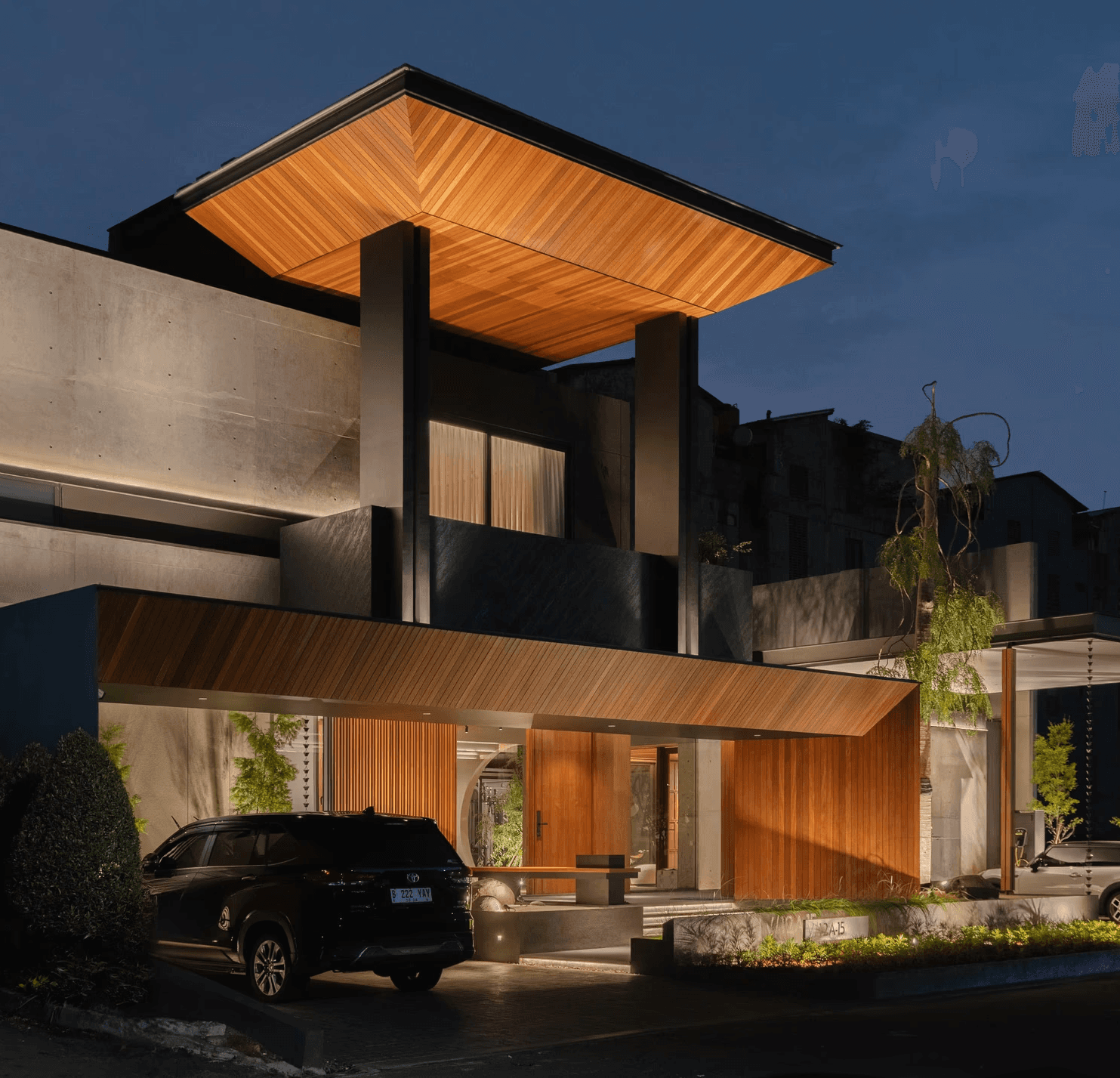
Niji House
PROJECT DESCRIPTION
Completed in 2024 in Tangerang Selatan, Niji House is a private residence designed for a career-driven couple seeking both comfort and long-term environmental efficiency. With a total built area of 913 m², the house is shaped by a singular architectural idea: the Central Core, an integrated vertical element that organizes structure, circulation, and environmental performance across three levels.
Location
Tangerang Selatan
Year
2024
Land Area
503 m²
Type
Residential
Project
Architecture

The project is driven by the ambition to create a home that performs as both sanctuary and system. The architecture balances openness with privacy, and efficiency with spatial clarity. At it's center, the house is conceived as a living environment that responds passively to climate, reducing reliance on mechanical systems while enhancing everyday comfort.


THE SPACE
The spatial organization revolves around the Central Core, which acts as the primary void and connective element. This vertical space distributes light and air throughout the house, ensuring that even deeper zones remain naturally illuminated and ventilated. The mass is divided into two wings, allowing the core to function as a breathing space, while bridges on the upper floors maintain visual and physical continuity. Zoning is carefully arranged to support daily rhythms. The first floor accommodates service and activity spaces, including a gym, yoga room, and home theater.
The second floor becomes the social heart, where living, dining, and kitchen areas are integrated into a continuous environment. The third floor is reserved for private bedrooms, offering a quieter and more intimate setting. A swimming pool is positioned between the first and second floors, creating a layered spatial experience while enhancing airflow and light distribution. The north-south orientation further strengthens cross-ventilation, allowing the house to remain open, bright, and naturally cooled.

THE FEEL
The architecture expresses clarity and restraint. Volumes are defined with clean lines, while material selections remain grounded and tactile. Natural stone, textured surfaces, and concrete form a cohesive palette that feels both solid and enduring. Light becomes an essential material, moving through the central void and across spaces throughout the day. The result is a home that feels open yet protected, calm yet responsive, where spatial experience is shaped by both form and environment.
PHOTO GALLERY
A project of this depth deserves to be seen in full. We've brought together a complete visual record of Niji House, every material, every view, every detail, for you to explore at your own pace.